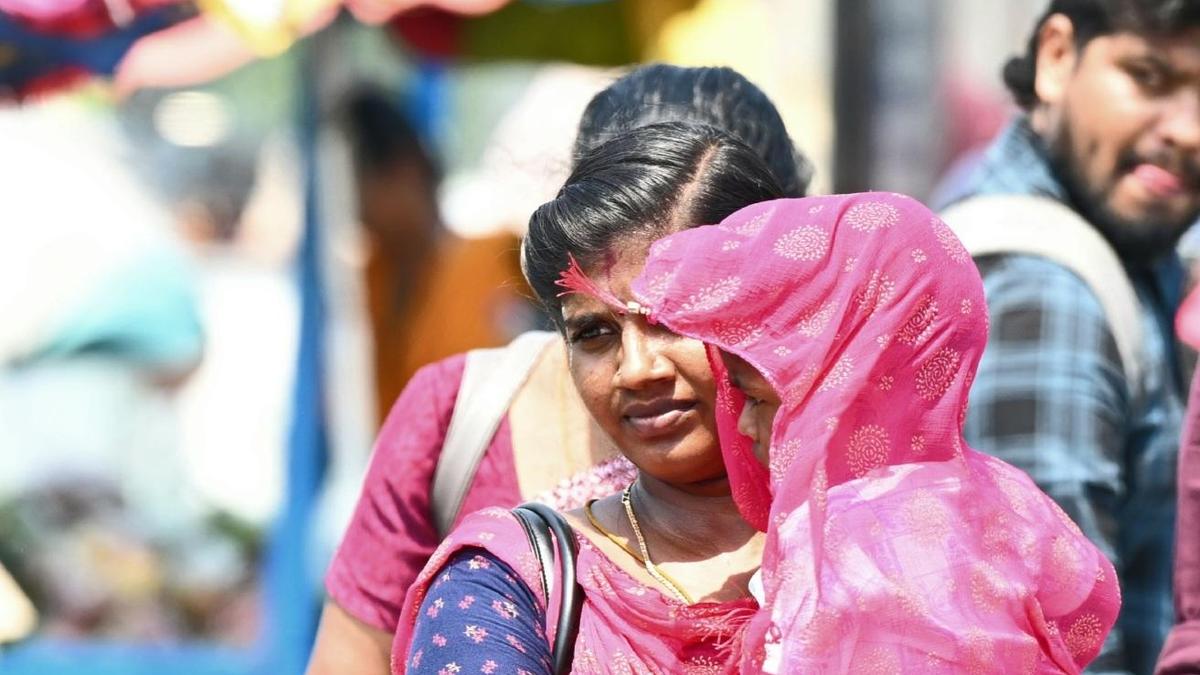
Large commercial complexes, textile shops, and jewellery showrooms blast cold air onto the high street in T. Nagar, Chennai, where the average summer temperature is over 35 °C.
Shoppers dart from one air-conditioned building to another. But these ACs also cause an urban heat-island effect, making it one of the top 20 most vulnerable spots exhibiting significantly higher temperatures than other areas in Chennai, according to Deena Hari Krishna, project manager, Auroville Consulting, a U.N.-backed centre advising on policies and sustainable practices.
What it takes to move heat action plans from advisories to mandates
To mitigate heat, buildings here may require passive cooling and ventilation using mechanical fans, which are designed to suck out hot air; operational advisories to set AC temperatures between 24 °C and 26 °C; and introducing energy efficient cooling systems. However, mitigating heat in T. Nagar may look completely different from other localities, he said.
“Climate initiatives for T. Nagar will differ from other hotspots like the Koyembedu market,” per Mr. Krishna.
Heat mitigation is integrated in Chennai’s Third Master Plan, led by Chennai Metropolitan Development Authority, and supported by C40 Cities and Community Jameel. It aims to build climate resilience and improve adaptive capacity to manage flood risks and urban heat islands by focussing on vulnerable spots based on surface temperature and building density, Mr. Krishna said.
Such localised planning for climate action is just emerging in India, experts pointed out. While all 34 Indian States and Union Territories have drafted or finalised their climate action plans, there are several obstacles to implementation, including inadequate leadership, institutional barriers or the quality of the plans, according to Oxford Policy Management.
Early State Action Plans on Climate Change (SAPCCs) suffered because of limited institutional capacity, inadequate financing, weak data systems, and fragmented coordination, a report by International Forum for Environment, Sustainability & Technology (iFOREST) found in 2025. The report suggested integrating SAPCCs into the state’s governance architecture and building strong knowledge systems that support action.
Climate in State policy
Nambi Appadurai, director of the Climate Resilience Practice at World Resources Institute-India (WRI-India) said that while early SAPCCs were often hurriedly conducted with a top-down approach, the second versions are more effective.
Governments with the support of think-tanks and researchers are also taking heat action plans and climate action from planning to implementation, making up for the lack of statutory status and financing.
Chandra Bhushan, founder-CEO of iFOREST, said integrating climate goals into State-level executive and legislative processes, such as requiring environment departments to present annual progress reports to their respective Assemblies, has been a useful way to drive on-ground action.
According to Mr. Appadurai, “Most climate plans lack clear ownership. But there are exceptions.” For instance, Odisha has cracked climate budgets, allowing them to track exactly where money is spent. Kerala has started to excel at disaster management. And Madhya Pradesh has established a robust knowledge platform for climate activities.
Each State grapples with different kinds of disasters, dictating their climate priorities. Tamil Nadu is at the forefront of climate action in India due to significant government buy-in, multi-sectoral efforts, and proactive investment, Mr. Appadurai said.
In 2024, Tamil Nadu established the Tamil Nadu Green Climate Company (TNGCC), a nodal agency for all climate action. Mr. Appadurai is on its governing council.
‘Responsibility matrices’
“Accountability is an incremental process,” Vishwas Chitale, fellow and lead, Climate Resilience, Council on Energy, Environment and Water (CEEW), said. Awareness and institutional capacity to tackle climate and heat action planning are evolving with training and workshops across departments.
CEEW has collaborated with various cities across India to integrate scientific tools that help cities measure implementation of HAPs, to help access the need for funds.
Mr. Chitale gave the example of Thane’s heat task force committee, which has a ‘responsibility matrix’ designed to strengthen inter-departmental coordination focusing on preparedness, response, and long-term mitigation. Thane allocated ₹1 crore in the 2025 budget to support measures such as cooling interventions and drinking water provision.
Currently, independent think-tanks and research organisations such as CEEW, Auroville Consulting, WRI-India, and others help build capacity and data sets and track performance.
Srinivas Krishnaswamy, CEO of New Delhi-based environment nonprofit Vasudha Foundation, said data portals can be essential to close the gap between raw data and actionable policy. For example, the portal of the Union government’s Revamped Distribution Sector Scheme, to improve efficiency in power distribution, provides State-wise progress on infrastructure upgrades and tracks loss reduction. This allows governments at all levels to monitor compliance and adjust funding priorities.
Another example is the PM Surya Ghar portal, which tracks rooftop solar adoption across States. The disaggregated data is publicly available and shows who is leading or lagging, pinpointing where policy tweaks can improve uptake.
Vasudha Foundation and NITI Aayog developed the ‘India Climate and Energy Dashboard’ to integrate data from various ministries and departments into a holistic picture of the national-level trajectory. It also monitors India’s progress towards its Nationally Determined Contributions.
Mr. Krishnaswamy said the dashboard receives over 1,000 pageviews a day, counting more than 6 lakh users since it was started in 2023, including Central and State government ministries and departments, public sector undertakings, academics, banking and financial services, insurance companies, industries, think-tanks, and civil society organisations.
Creative financing
Instead of seeking separate funding for climate action, governments can include a climate lens in all their development and infrastructure plans, Mr. Bhushan said.
Mr. Appadurai said successful adaptation is when basic development indicators such as income, education, and health continue to improve despite climate shocks like droughts or floods. Whether it’s a city’s ability to withstand heavy floods without water stagnation or getting through a summer without power cuts, on the ground climate resilience is good infrastructure development.
“Good adaptation is good development through a climate lens,” he said.
In Maharashtra’s Ratnagiri, the administration along with iFOREST launched a unique district development-cum-climate action plan in February. Instead of a separate climate document, it integrated climate resilience directly into the three-year development plan, Mr. Bhushan said.
Drafting it brought together senior officials from the district administration, line departments, and representatives from the State environment department, plus technical experts and local stakeholders.
Mr. Chitale said that with the 16th Finance Commission recommending making heatwaves a nationally notified disaster, a significant amount of finance will become available for cities to strengthen their heat resilience.
Tamil Nadu announced a Rs 1,000-crore corpus for the TNGCC. Although the full amount is yet to be in place, the State has identified and provided financial support in critical areas like waste management and water conservation, Mr. Appadurai said.
Mr. Krishna said convincing governments to invest in climate-specific infrastructure is difficult, so projects need to be structured such that they can pull from diverse funding sources, such as municipal budgets, private investment, corporate social responsibility or international grants.
Mahima Jain is a resident fellow at the Climate Change Media Hub, Asian College of Journalism, Chennai.





+ There are no comments
Add yours