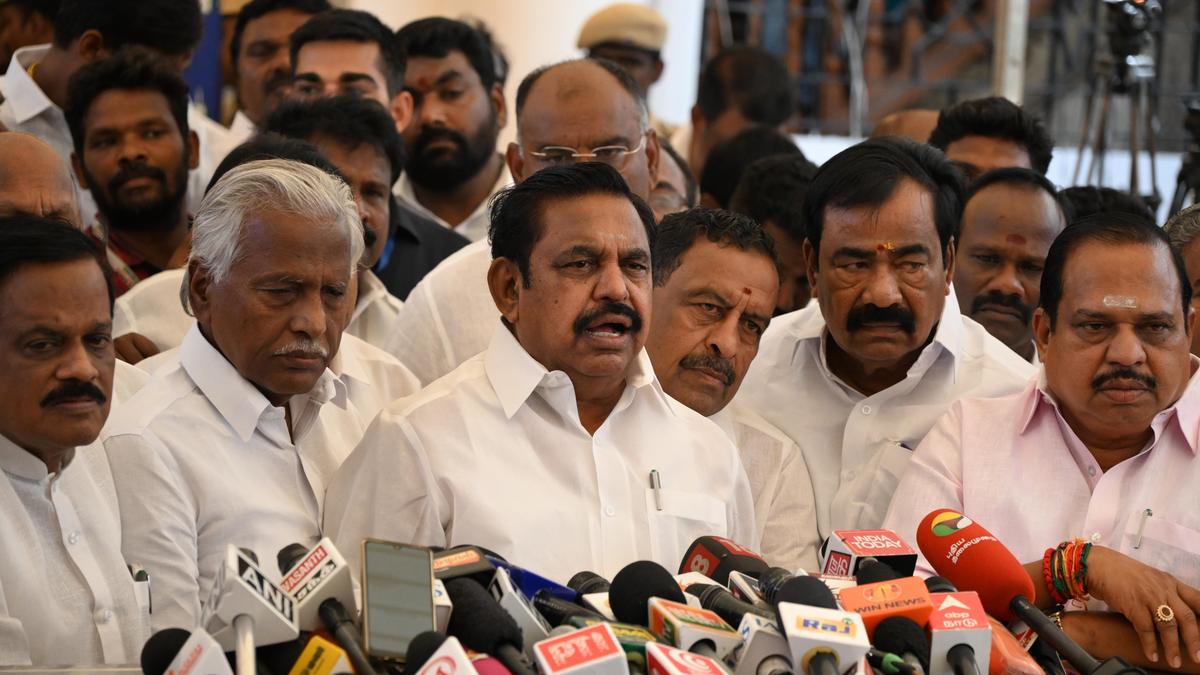
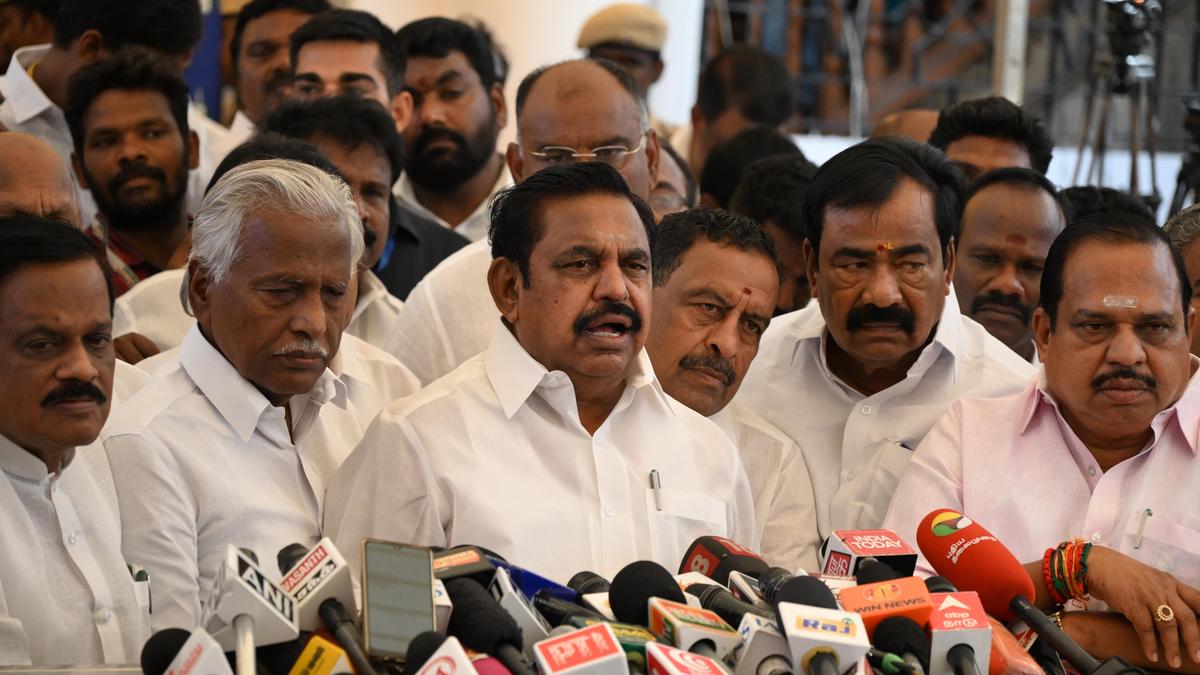
AIADMK leader Edappadi K. Palaniswami addressing the media along with party MLA’s after the confidence motion in the State Assembly, Secretariat in Chennai on May 13, 2026.
| Photo Credit: B. Jothi Ramalingam
The story so far: The rift in the AIADMK widened on Wednesday (May 13, 2026) night in the wake of the party general secretary Edappadi K. Palaniswami removing 26 rebel district secretaries including 12 legislators from their positions. Among those who were sacked from their posts were former Ministers C.Ve. Shanmugam and S.P. Velumani. Earlier in the day, the division in the organisation was out in the Assembly when 22 legislators, owing allegiance to Mr. Palaniswami, opposing the trust motion, moved by the Tamilaga Vettri Kazhagam (TVK) regime and 25 MLAs favouring the motion.
Also Read | Anti-defection law applies even if a faction splits from a party: Supreme Court
What is the legal position on defections?
As per the Tenth Schedule of the Constitution and the Members of the Tamil Nadu Legislative Assembly (Disqualification Ground of Defection) Rules, 1986, there are two grounds for disqualification in the event of defection — when a member voluntarily gives up membership of his or her political party and when a member votes or abstains from voting contrary to any direction issued by his or her political party. It remains to be seen whether Mr. Palaniswami is going to cite the second scenario, which appears to be a straightforward instance of defection. In September 2017, the then Assembly Speaker P. Dhanapal referred to the first scenario, while disqualifying 18 AIADMK MLAs for having given representations in the previous month to Governor Ch. Vidyasagar Rao, expressing their lack of confidence in Mr. Palaniswami, who was the Chief Minister.
Comment | The anti-defection law is facing convulsions
How have courts of law viewed the subject?
Over the years, different judicial pronouncements have been given and in some cases, judgements have differed from each other. The camp led by Mr. Palaniswami cites the Supreme Court’s judgement in the Shiv Sena case of May 2023 wherein the Court addressed one of the issues which is of relevance to Tamil Nadu. In Maharashtra too, conflicting whips were issued by rival groups to members of the Shiv Sena. Eventually, the Court held that “to hold that it is the legislature party which appoints the Whip would be to sever the figurative umbilical cord which connects a member of the House to the political party.” It concluded that “the political party, and not the legislature party, appoints the Whip and the Leader in the House.”
Comment | The hollowing out of the anti-defection law
What are the positions of the rival groups?
Mr. Palaniswami is of the view that he, being the general secretary of the party, had appointed his colleague-former Minister “Agri” S.S. Krishnamurthy as the whip of the legislature party and the latter, in turn, conveyed through e-mail, registered post and SMS, about the line to be pursued by the legislators in the Assembly on the trust motion. He claims the AIADMK’s legislature party has been constituted with himself at the helm. He also contends written consent has been secured from all the legislators with regard to his election as the leader of the legislature party.
However, Mr. Shanmugam dismisses Mr. Palaniswami’s account of events and asserts that no election has taken place. He also demands that the resolution with regard to the appointment of the leader and the whip be made public. On the contrary, his group has nominated persons for different posts in the legislature party. Mr. Shanmugam and Mr. Velumani emphasise their intention is not to cause any split in the party and acknowledge that Mr. Palaniswami remains the general secretary of the party.
Also Read | Meant to protect free speech from anti-defection law, ‘merger’ is now a defence for joining a rival party
What is the course of action expected from Assembly Speaker J.C.D. Prabhakar and the two groups of the AIADMK?
If Mr. Palaniswami gives a petition to the Speaker requesting him to initiate disqualification proceedings, Mr. Prabhakar can set the process in motion by sending notices to the legislators concerned. Ordinarily, seven days will be provided to such members for giving their comments. Upon the receipt of the members’ responses, the Speaker can either decide on his own or refer the matter to a committee and await the panel’s report, after which he can take a final call.
Else, the Speaker can conclude that the AIADMK’s legislature party has not yet been constituted and may not take cognisance of the petition, if any, given by the Palaniswami camp.
Published – May 13, 2026 10:42 pm IST






+ There are no comments
Add yours